
Category: Uncategorized

A note on AI use here

It’s hard to escape the long arm of ChatGPT and Claude. Since LLMs make almost all knowledge work easier, there is an overwhelming incentive to use them everywhere. As a result, we can see the hallmarks of artificial intelligence at every turn. I would challenge you to read five LinkedIn posts and not see more than a few that feel written or heavily influenced by AI.

I heard the term “cognitive surrender” recently and it has been fascinating to think about in the context of AI. Shaw and Nave describe it in their research as that state where “the decision-maker no longer constructs an answer, but adopts one generated by an external system”. I think we have all been there recently: that moment in time where we are starting a task, begin to engage the mental gears, and then reflexively reach for Claude give you a hand.

I am a strong advocate for AI, generally. I think we are only beginning to understand the positive and negative impacts of this transformational technology. The AI debate raises important questions about creative work though. It also raises questions about authenticity and the homogenization of creativity toward statistical similarity.

Which brings me to this weblog.

I was reading this article on Legibility of Effort today, which was a solid dissection of level-of-effort as a signal for how worthwhile content might be. Anyone can have a weblog. With LLMs, you can create a post and have it live in minutes. Since January 2023 I have created 33 posts for voxelwise.com. Today, you could legitimately create more than that within a few hours.
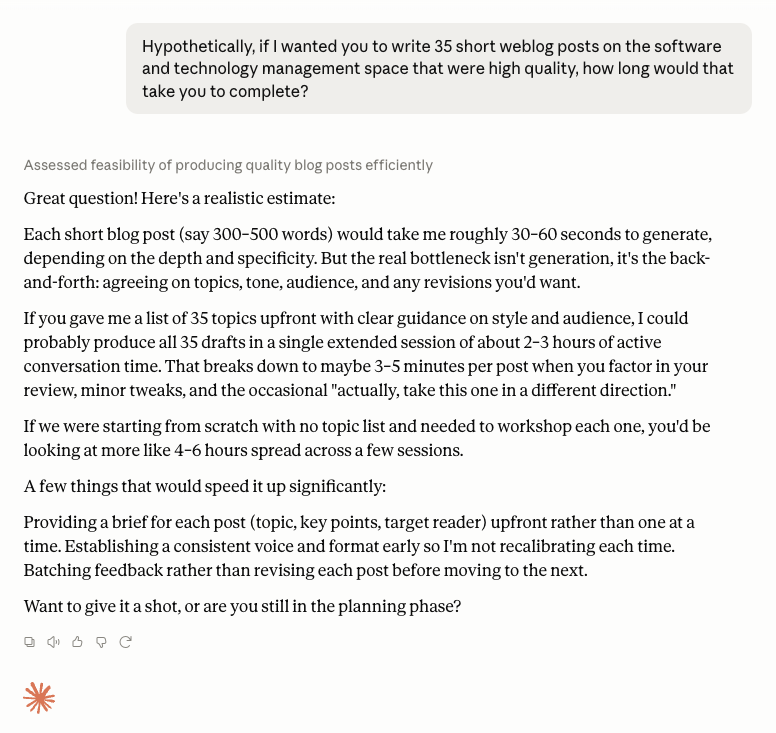
Is it really about quantity though? I also have no doubt that Claude can create articles that are higher quality than my own. So, is it strictly about quality either? Once the author fully surrenders, aren’t you just getting whatever statistical view that the frontier models captured in their training?

When I first started this site in 2023 I made a small decision to include an original photograph at the top of every article. The photo was aways loosely, sometimes very loosely, related to the text in some way. Mostly, it was about sending the reader a signal that this wasn’t just some stock photo slapped onto some random text. There would be craftsmanship here. No selling the screen real estate for ads. No random photos from a Google image search. Just content from someone with a viewpoint to share. It was, and is, everything that I wanted from a personal weblog. All of it created with the intent of being the management resource I wish I had when I first started.

I have added a few sentences to the About page here on the use of AI within this site. In that note I am committing publicly to Voxelwise being my own creative work. To the degree that I have any readers, I want them to know that and see that signal. It is also an affirmation for myself about what kind of creator I want to be. It is about quality over quantity. It is about craftsmanship and taste. Most importantly, it is about whatever sliver of humanity and connection that can be created through words. That seems worthwhile, and worth being clear about.

Photo: Los Angeles International Airport, as seen from a Cessna 172 flying through the Los Angeles Special Flight Rules Area. My friend Matt was flying that day.

Even the things that don’t matter somtimes matter

Care about the task in front of you, even if you don’t have to. You never know when it will make a difference.

It was a pivotal moment. My boss had just told the president of the company that he would be leaving in two weeks. The president had asked my boss who he recommended as a replacement. My name was mentioned. Half the battle was won, but major hurdles remained.

The president left his office and stopped by the Director of Customer Service’s cubicle. She was a powerful voice at the company, often serving as a critical advisor to executives. The president asked: “what would you think about Craig as the new manager of the software group?”.

“Craig is pretty good. He works well with my team and seems to be customer-focused. He even got a 96% on the LSU test.”

What just happened?

At this pivotal moment, when my candidacy for manager could be made or broken by the opinions of others, the Director of Customer Service brought up the fact that I aced the daily tests during the weeklong customer training I attended when I started with the company. 

Most new employees didn’t care about the tests. My new boss even told me not to worry too much about them, since he never saw the grades. I cared anyway, reviewing my notes to give the best answers I could. Little did I know that my good scores impressed some people. Those people reflected their positive views back to the company president when he asked one year later.

It is impossible to care deeply about everything. In fact, saying “yes” to everything is perhaps the fastest path to burnout. At the same time, it would be wrong to not care when people are forming fresh opinions about you. Put another way, just because you can ignore something doesn’t mean you should.

I could have gone home 15 minutes early if I had just skipped the daily test during LSU training. After a long day of learning laser light scattering, I definitely wanted to. At the same time, it felt important. I stayed. I studied. In the end, it made all the difference. So, pick your battles wisely knowing that some of them are investments in the future.

Photo: Railroad sign near Boreas Pass on the continental divide in Breckenridge, Colorado.

Don’t throw away your shot

There are pivotal moments that can ruin promising careers. Don’t lose it all because you were self-focused and couldn’t stop yourself.

I learned a lot about how the brain works while in grad school. One thing I learned is that the brain largely works through inhibition. That is, you don’t so much “hit the gas” to do something as opposed to “tap the brakes” to ensure the right things happen. 

Think about that one moment where you wanted to do something so bad but decided not to. It could be something innocent, like wanting to call in sick and sleep longer but you went to work anyway. More dramatically, it could be something like a time when you wanted to yell at your boss but kept your mouth shut instead.

Most decisions have a small blast radius, but there exist a small number of pivotal decisions with the power to blow up entire careers. The ability to stop yourself and inhibit your initial response is a critical skill for leadership. It really is the thing that separates long-term success from sudden and dramatic failure. This is because it takes years to build the foundation for success and only moments to tear it all down.

Let’s explore four short examples where leaders, and people that I had respected, threw it away.

It’s not your money

An acquaintance was the head of a local city department. He was seen as an effective leader, well liked by his staff and city leadership. Things were going well, but this individual had a deep political streak. The Republican candidate for mayor stopped by his office and they talked about how desperately the city needed conservative leadership. The acquaintance agreed, and (allegedly) gave the candidate money out of the petty cash box to help fund his campaign. Let’s pause for a second. This was city money given to a political candidate – a huge mistake. A disgruntled member of his staff reported the incident and the leader was investigated by law enforcement. He quit the job and moved out of town before he would be forced to step down. Years of investment gone in an instant because he couldn’t stop himself in that moment.

Don’t date your followers

A new minister moved to town and was a huge hit with his congregation. He brought a new, youthful energy to his work that inspired and invigorated the church. Over several years he built a dynamic new organization, always pushing to do more and serve the community in new ways. This included helping to heal wounds from decades past, when a previous minister engaged in unprofessional sexual conduct with congregants. The new minister was a superstar.

Five years after he first arrived the minister was leaving for a larger role with a bigger congregation. As he moved away it became apparent that the minister was cheating on his wife with one of the local congregants. He continued to behave badly in his new role. Three years later he was under investigation and put on administrative leave for inappropriate relationships with congregants. He was dismissed from the congregation and ultimately resigned his fellowship with the larger faith pending allegations of ministerial misconduct. An incredibly promising minister and a career that benefitted hundreds or thousands of people – all of it thrown away because he couldn’t be trusted with the people of his congregation(s).

Perceptions matter

The best conference I attended while in academia was the “New Horizons in Human Brain Imaging” gathering in Hawaii. Small conference. Great talks. Amazing location. On the last night of the conference in 2010 I was with several attendees in the hot tub hanging out and talking shop. As we talked one of the professors and a postdoc started touching and whispering to each other. They jumped out of the hut tub and chased each other around for a minute before chasing each other into the bushes. Another attendee mentioned “isn’t he married?”, to which a second member of the hot tub responded in the affirmative. Rumors only grow after an episode like that. Conversation about the conference continued for years afterward.

The ultimate misappropriation of trust

The worst cases of professional malpractice were those I saw in grad school. Twenty years ago the Psychological and Brain Sciences department at Dartmouth College had a very permissive atmosphere. The lines between professors, postdocs, and grad students got very blurry. It was not unusual to walk into a local bar* and see professors drinking with grad students like they were in their 20s again.

The grad students knew which professors were “handsy” and who got a little too close for comfort. Several people switched labs when they found out the hard way that their advisor was a creep. Some had affairs with professors. Permissiveness continued to escalate over time. Eventually, three professors clearly crossed the line and were dismissed. The resulting lawsuit cost the College at least $14M dollars. The details of the situation are worth their own separate post, but suffice it to say that three promising professors ruined their reputations and their careers because they couldn’t control themselves**. More critically, they hurt a lot of people over many years in the process. The misconduct allegations in 2018 were a contributor to the department chair taking his own life one year later.

Summary

I have heard leadership defined as helping any group of two or more people achieve their common goals. We leverage respect, influence, and power to make that happen and move our group toward those goals. That same respect, influence, and power can also be misappropriated to further selfish ends. This action is incisive, and it cuts deep. Not only do we abuse the trust of those within our leadership but we harm our own advancement by behaving badly.

Don’t fall into this trap. Don’t throw away your shot at greatness. Make sure to hit the brake pedal when the time is right. It matters, both to you and the people under your leadership.

* Hanover, NH was a small town of 8,000 people, so you run into others often.

* All the more ironic that a key area of research for one of the professors was failure of self-regulation: https://www.ncbi.nlm.nih.gov/pmc/articles/PMC3062191/

Photo: A Founder’s Fizz, from the Richard Rodgers Theatre in 2016 as we watched Lin-Manuel Miranda and the original cast of Hamilton perform. “My Shot” is one of the best songs of the show.