A note on AI use here

It’s hard to escape the long arm of ChatGPT and Claude. Since LLMs make almost all knowledge work easier, there is an overwhelming incentive to use them everywhere. As a result, we can see the hallmarks of artificial intelligence at every turn. I would challenge you to read five LinkedIn posts and not see more than a few that feel written or heavily influenced by AI.

I heard the term “cognitive surrender” recently and it has been fascinating to think about in the context of AI. Shaw and Nave describe it in their research as that state where “the decision-maker no longer constructs an answer, but adopts one generated by an external system”. I think we have all been there recently: that moment in time where we are starting a task, begin to engage the mental gears, and then reflexively reach for Claude give you a hand.

I am a strong advocate for AI, generally. I think we are only beginning to understand the positive and negative impacts of this transformational technology. The AI debate raises important questions about creative work though. It also raises questions about authenticity and the homogenization of creativity toward statistical similarity.

Which brings me to this weblog.

I was reading this article on Legibility of Effort today, which was a solid dissection of level-of-effort as a signal for how worthwhile content might be. Anyone can have a weblog. With LLMs, you can create a post and have it live in minutes. Since January 2023 I have created 33 posts for voxelwise.com. Today, you could legitimately create more than that within a few hours.
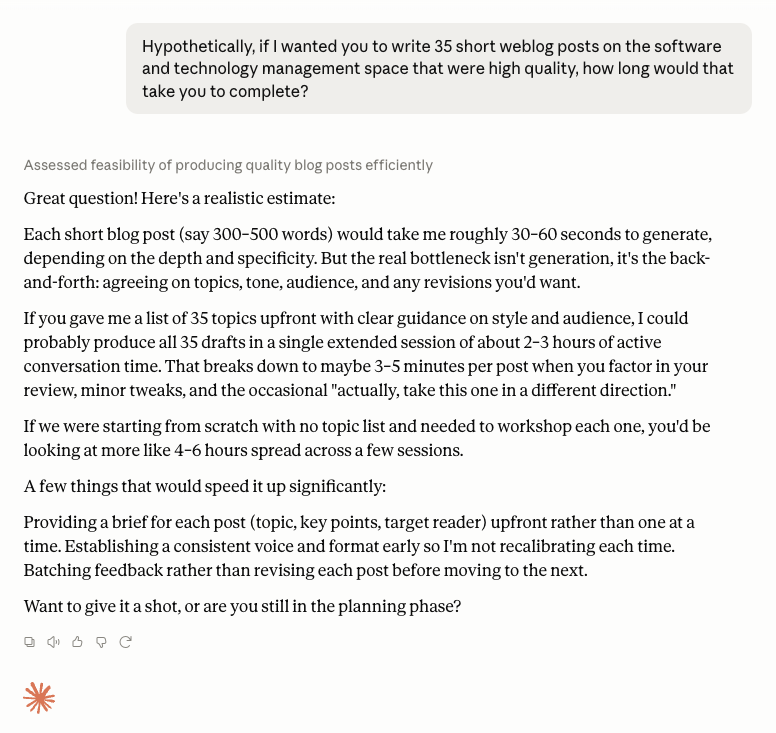
Is it really about quantity though? I also have no doubt that Claude can create articles that are higher quality than my own. So, is it strictly about quality either? Once the author fully surrenders, aren’t you just getting whatever statistical view that the frontier models captured in their training?

When I first started this site in 2023 I made a small decision to include an original photograph at the top of every article. The photo was aways loosely, sometimes very loosely, related to the text in some way. Mostly, it was about sending the reader a signal that this wasn’t just some stock photo slapped onto some random text. There would be craftsmanship here. No selling the screen real estate for ads. No random photos from a Google image search. Just content from someone with a viewpoint to share. It was, and is, everything that I wanted from a personal weblog. All of it created with the intent of being the management resource I wish I had when I first started.

I have added a few sentences to the About page here on the use of AI within this site. In that note I am committing publicly to Voxelwise being my own creative work. To the degree that I have any readers, I want them to know that and see that signal. It is also an affirmation for myself about what kind of creator I want to be. It is about quality over quantity. It is about craftsmanship and taste. Most importantly, it is about whatever sliver of humanity and connection that can be created through words. That seems worthwhile, and worth being clear about.

Photo: Los Angeles International Airport, as seen from a Cessna 172 flying through the Los Angeles Special Flight Rules Area. My friend Matt was flying that day.


Even the things that don’t matter somtimes matter

Care about the task in front of you, even if you don’t have to. You never know when it will make a difference.

It was a pivotal moment. My boss had just told the president of the company that he would be leaving in two weeks. The president had asked my boss who he recommended as a replacement. My name was mentioned. Half the battle was won, but major hurdles remained.

The president left his office and stopped by the Director of Customer Service’s cubicle. She was a powerful voice at the company, often serving as a critical advisor to executives. The president asked: “what would you think about Craig as the new manager of the software group?”.

“Craig is pretty good. He works well with my team and seems to be customer-focused. He even got a 96% on the LSU test.”

What just happened?

At this pivotal moment, when my candidacy for manager could be made or broken by the opinions of others, the Director of Customer Service brought up the fact that I aced the daily tests during the weeklong customer training I attended when I started with the company. 

Most new employees didn’t care about the tests. My new boss even told me not to worry too much about them, since he never saw the grades. I cared anyway, reviewing my notes to give the best answers I could. Little did I know that my good scores impressed some people. Those people reflected their positive views back to the company president when he asked one year later.

It is impossible to care deeply about everything. In fact, saying “yes” to everything is perhaps the fastest path to burnout. At the same time, it would be wrong to not care when people are forming fresh opinions about you. Put another way, just because you can ignore something doesn’t mean you should.

I could have gone home 15 minutes early if I had just skipped the daily test during LSU training. After a long day of learning laser light scattering, I definitely wanted to. At the same time, it felt important. I stayed. I studied. In the end, it made all the difference. So, pick your battles wisely knowing that some of them are investments in the future.

Photo: Railroad sign near Boreas Pass on the continental divide in Breckenridge, Colorado.

Artemis II – Earthset

The imagery coming back from the Artemis II mission is phenomenal. This photo of the Earth setting behind the moon is one for the ages. Check out more photos at the Artemis II multimedia page on Flickr.

The lunar surface fills the frame in sharp detail, as seen during the Artemis II lunar flyby, while a distant Earth sets in the background. This image was captured at 6:41 p.m. EDT, on April 6, 2026, just three minutes before the Orion spacecraft and its crew went behind the Moon and lost contact with Earth for 40 minutes before emerging on the other side.

In this image, the dark portion of Earth is experiencing nighttime, while on its day side, swirling clouds are visible over the Australia and Oceania region. In the foreground, Ohm crater shows terraced edges and a relatively flat floor marked by central peaks — formed when the surface rebounded upward during the impact that created the crater. Credit: NASA

Delegate the Reading

A small pro tip for building a learning organization.

Many years ago I stopped having enough time to read all the books I wanted to read. It wasn’t just a function of limited spare time. A long day of Zoom meetings during a global pandemic has a tendency to exhaust even the most hardy souls. Watching a TV series I have already watched three times is sometimes a bit easier than engaging in critical thinking.

So, with limited time and limited energy, how do you prioritize your investments?

Easy, you do the same thing you do every day as a leader.

You delegate.

In conversations across my organization you can pretty quickly identify who the curious readers are. These are the folks that see reading as a key element of their career growth and tend to always have a “next book” that they want to read to hone their craft. Once you find these individuals your goal is to buy them tons of books, including a few from your own future reading list.

The benefits of this approach are manifold:

• Voracious readers love getting more books

• It leads to high quality conversations when discussing their book review

• You will know which books are engaging and worth your time

• There are even more high quality conversations once you finish reading the book yourself

Building a learning organization requires investment from everyone. For leaders, it means a monetary investment (buy the books), a time investment (discussing the books), and a hard requirement to remain curious. For direct and indirect reports, it requires an investment of time (read the books), and a commitment to remain engaged with their senior leader.

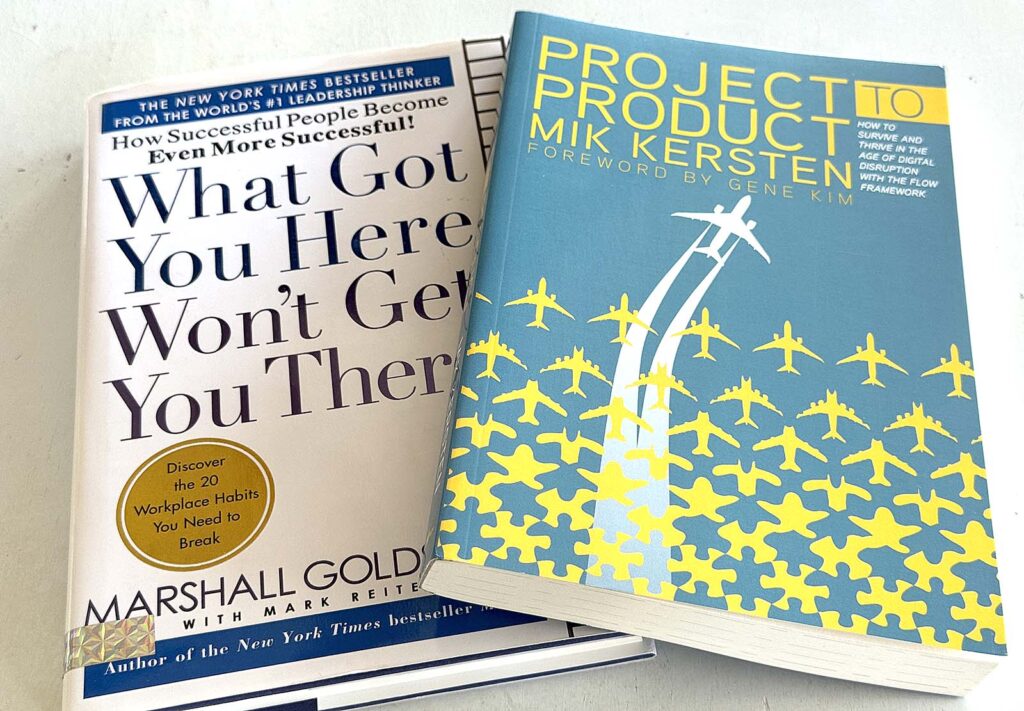
This method provides huge value in both directions. I never would have stumbled upon Project to Product by Mik Kersten without a recommendation by one of my product managers. On the flip side, I have bought more copies than I can count of What Got You Here Won’t Get You There by Marshall Goldsmith for members of my org. It’s one of the most common pieces of guidance that I give to rising leaders.

Did you find a particularly good book? Buy it for the whole team. It’s an effective way to signal “this is what resonates, and we should all take a look.”

TI-86 Overhaul – OLED Display Integration

In the first post of this series we discussed the background of the project: https://voxelwise.com/2025/11/ti-86-overhaul-backstory/

In the second post we did the reverse engineering to understand the display data for the TI-86: https://voxelwise.com/2025/11/ti-86-overhaul-screen-data-protocol/

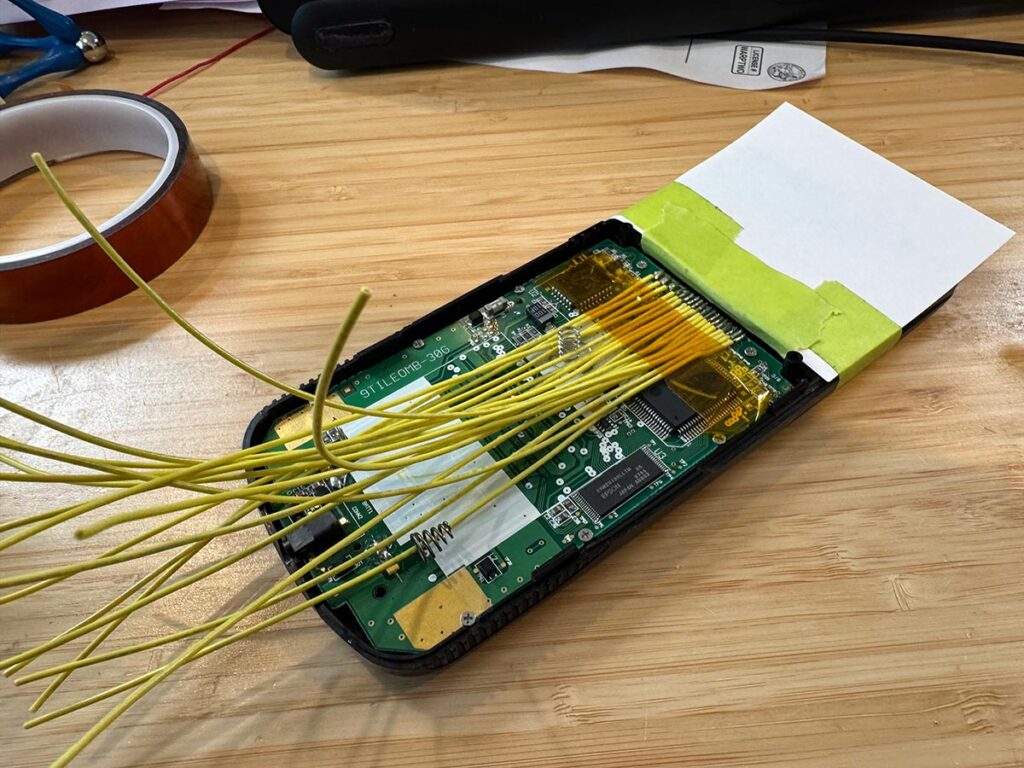
Now, let’s use what we know and send that data to a new display.

Read More

TI-86 Overhaul – Screen Data Protocol

Alright, let’s get down to business.

Our goal is to change the screen on a TI-86 calculator with something new. See the original post for background: https://voxelwise.com/2025/11/ti-86-overhaul-backstory/

If we are going to put a new screen in the TI-86, then we will need to understand how the current screen is getting data. With any luck, we can then parse that data, transform it, and output the screen data to a modern display with a different protocol.

Cracking open the calculator case, we have our first bit of info: there are 18 conductors in the ribbon cable. Maybe some kind of parallel interface? Let’s see if anyone else on the Internet has blazed a trail and identified what they are.

Read More

TI-86 Overhaul – Backstory

This is a Texas Instruments TI-86 calculator. More to the point, this is MY Texas Instruments TI-86 calculator. Released in 1996, it was the pinnacle of TI graphing calculators when I bought it. 

I have owned a lot of graphing calculators over the years. I somehow talked my dad into getting me a TI-81 in middle school. I spent hours programming in TI-BASIC, even porting code from a library book to create a Sierpiński triangle on the 96×64 screen. It was a joy. From there, I bought myself a TI-85 in high school. I got the TI-86 my freshman year in college. Later on as an undergrad, I spent some time with a TI-92 and TI-89 just for kicks.

The TI-86 was always my favorite. So it has been for the last twenty-ish years: a TI-86 for daily use and a TI-89 for the memories.

Until a few weeks ago.

I hit the “On” button on the TI-86 and was greeted with random noise on the screen. I changed the batteries. Nothing. I replaced the lithium backup cell. Nothing. I performed every kind of reset I could think of. Nothing. To the best of my knowledge, it appears that a RAM chip failed.

Damn.

So, I had a TI-86 with a good screen and a bad main board. Not content to let a multi-decade companion walk into the sunset, I went on eBay and bought another TI-86 with a bad screen and a good main board. A few hours of Frankenstein soldering later, and my original college calculator was working again. I even threw on a colorful set of keys from a TI-83.

But… why stop there?

My one complaint about the TI-86 has been the screen. While it was a substantial upgrade over the TI-85, without a backlight it was always hard to read. Let’s fix that. Over the next few posts we will explore the TI-86 display protocol and give it the OLED upgrade that it always deserved.

Wouldn’t want to let a good friend down.

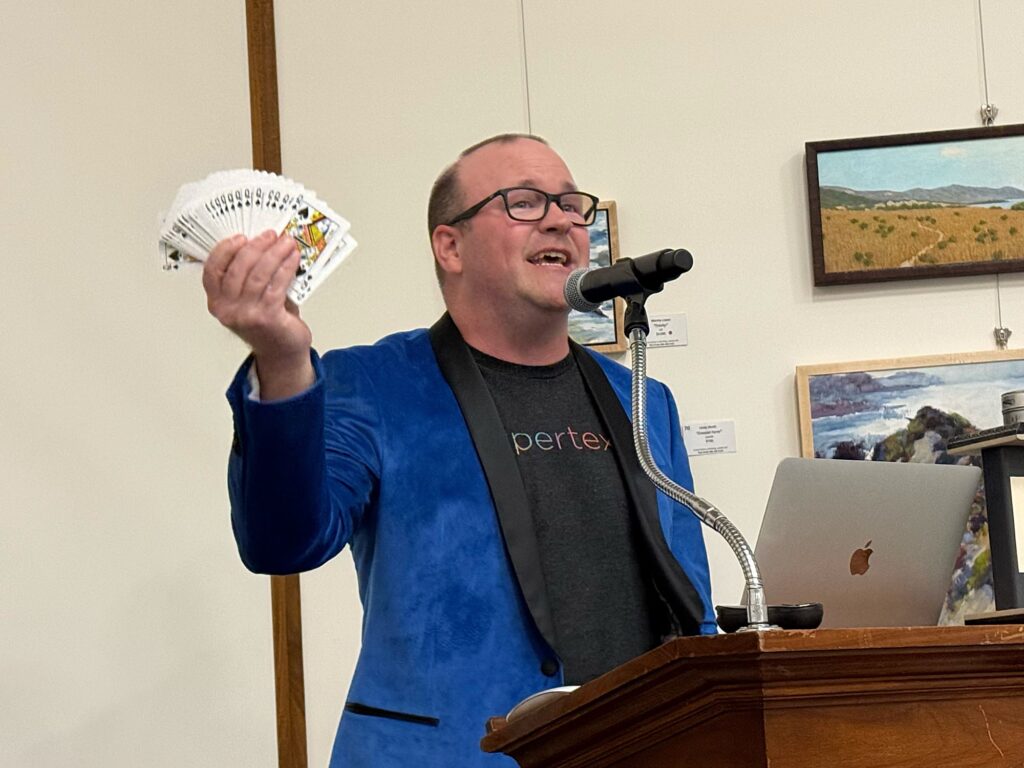
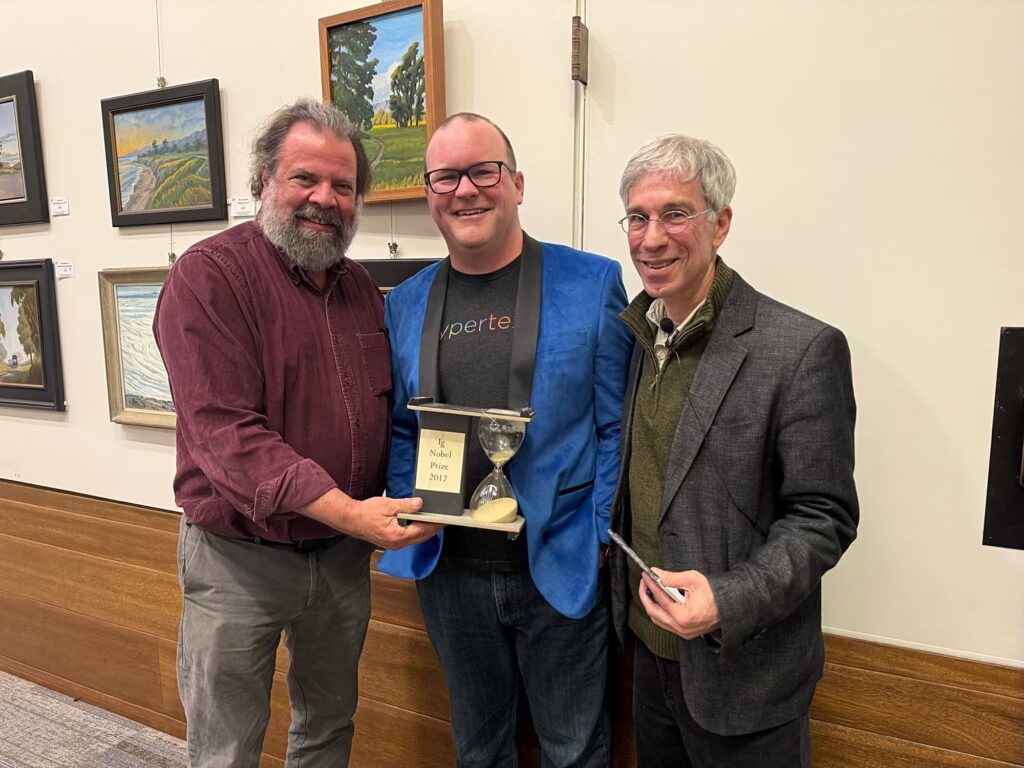
Santa Barbara Ig Nobel Presentation

It isn’t every day that Marc Abrahams, founder of the Annals of Improbable Research and creator of the Ig Nobel prize, stops by your small town on the California coast.

Even more rare is when he invites you to give a presentation.

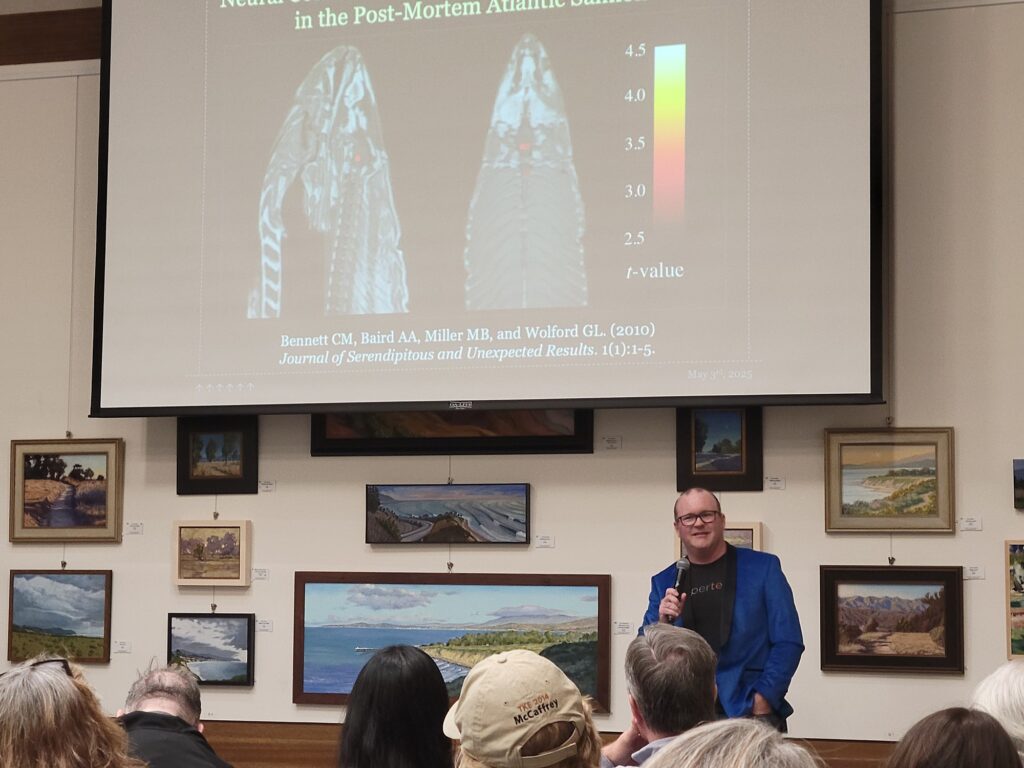
Had a great time on Saturday retuning to my academic roots and, once again, answering the question of what a dead salmon has to do with the principled control of false positives in neuroimaging.

From left to right: Michael Miller (my postdoc advisor), me, and Marc Abrahams. I brought the original 2012 Ig Nobel prize to the presentation. It usually sits at home above our fireplace.

Don’t lose your humanity in a layoff

[Written in July 2024,  but posting now]

Don’t lose your humanity when you have to make the tough decisions.

I can hear the train coming, and I wish like hell it would never arrive.

It is Saturday morning. In 72 hours approximately 25% of the employees in my org will be laid off. I won’t go into why. Suffice it to say that costs are up and revenue is down. The net result is that I have to do one of the most terrible actions that a manager may need to take: dismiss high performing employees that did nothing wrong but will lose their job regardless.

It is said that you never really become a manager until you have to manage out an underperformer. The struggle of coaching someone to do better, the realization that they are unable or unwilling to improve, and the action to remove someone from a company is profound. I am still early enough in my career that I can remember the separation meetings of every person that I have let go. Yes, even the first one ten years ago.

The small solace of managing out an underperformer is that they are not delivering. Through coaching, 1:1s, and performance plans we can try to coax and cajole people into doing better. If they don’t want to change then it is the individual who decided to leave by not engaging.

The opposite is true in a layoff. These are often people who have been doing everything right. They have been working hard to deliver impact for the company and provide what is needed within their teams. Then, suddenly, we tell them “thanks for the hard work, but we’ve decided that we don’t need you any more”.

The dollars-and-cents of a layoff, and the spreadsheets that accompany them, very intentionally work to depersonalize the decisions. People become a column, a row, a single cell. We are playing a game of Tetris to achieve a certain dollar amount or to obtain a percent savings target. I don’t know an empathetic soul would could survive the process without putting the human element somewhat to the side. As is true of many/most terrible actions, it often slowly becomes a case of “I am just doing my job”.

Tuesday will come. I will do the right thing for the company and complete the layoff. Then, Wednesday will come and the sun will rise again. The Earth will spin on. I will march forward with the remaining 75% of my org, laboring to manage the massive changes. It will not be lost on me how terrible the layoff is though, nor will I forget the sacrifices of hard working people that were necessary to reduce our costs. They are more than just entries in a spreadsheet.

Photo: The Santa Ynez mountains above Summerland, CA burn during the Thomas Fire in December 2017. At the time it was the largest wildfire in California history.

Going to gemba, any day now

If you want to enable change then you must be an active participant.

It was the mid-2010s and I was working as the head of software for a local scientific instrument manufacturer. The executives were looking for ways to increase velocity and urgency. They felt that the company had slowed down significantly in the last few years. 

During an all hands meeting the President of the company got up and described how we would be enacting lean manufacturing principles. One element of this approach was “going to gemba”, with gemba representing where value was created within the company.

The President told anecdotes about leaders putting their office, or at least a desk, right on the manufacturing line. The goal was to see and hear the opportunities to unblock work and improve processes. This was part of genchi genbutsu, where the only way to understand the manufacturing floor was to actually go there. Toyota executives would talk about the daily “gemba walk” where they would move through the manufacturing center to observe and identify inefficiencies.

Following the all hands we collectively waited for a member of the executive staff to move their office from the front of the building to the manufacturing area in the back. At the very least we expected them to begin regular walks through the area.

It never happened.

Nothing undermines change management like hypocrisy. In this instance, the leaders of the company were asking everyone at the company to make major changes. People were expected to suffer whatever sacrifices were necessary to make those changes successful. We were told that this was required to ensure that the company would be competitive into the future. Then, when it came time to enact those changes, it was clear that the executives were not willing to make sacrifices themselves.

Why should anyone else in the company commit to a major change when the executives refused to change any element of their work?

Two years later we got a new CTO who was hired by the executives to improve R&D and manufacturing. The first thing he did was kick an engineer out of a well-placed R&D cubicle so he could sit at the intersection between R&D and manufacturing areas. This resonated with everyone in both departments. The message was clear: he was there to be a part of the problem solving.

In the end, there are two lessons to take away. First, leading by example is critical and nothing torpedos change management like hypocritical “for thee, but not for me” leadership. Second, it does pay dividends to get close to the value creation in your company. Maybe you don’t have to give up that front office 100% of the time, but set up shop in the back of the building at least a few times per week. Your gemba is likely there.

Photo: One last peek at my desk at Amazon before we moved to a new office in downtown Santa Barbara, CA. We were in the new office for about two months before COVID hit and we scattered to work remotely.