Author: prefrontal

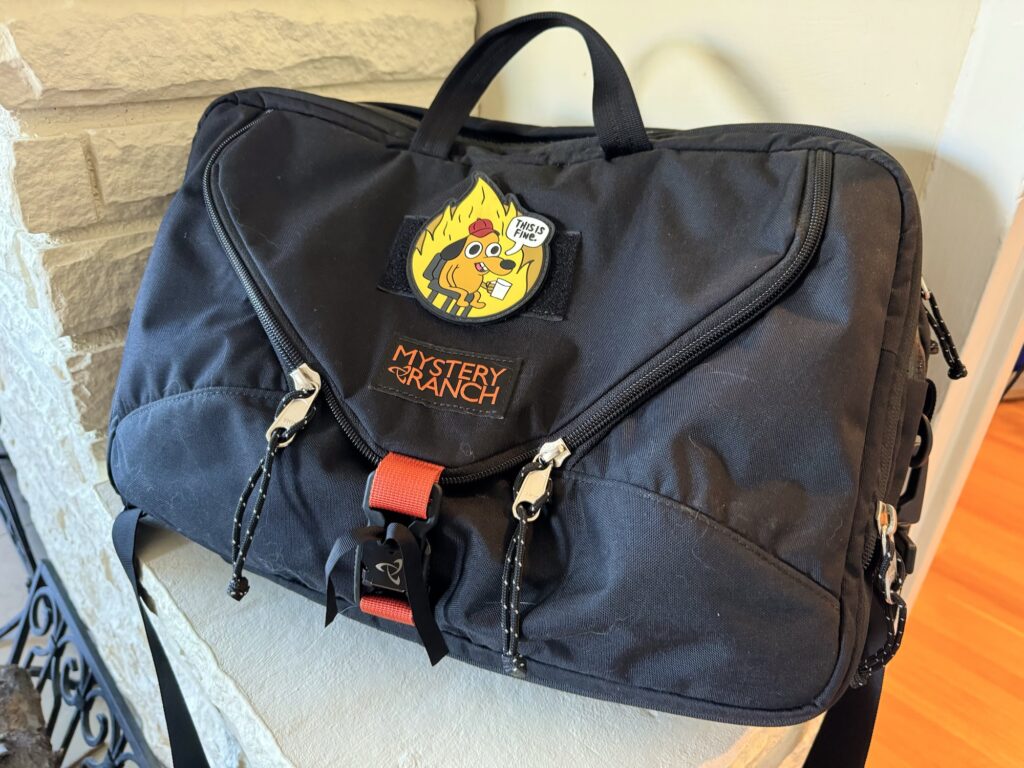
Gear: Mystery Ranch 3 Way Bag

Looking for a great shoulder bag to haul your tech when flying? Check out the Mystery Ranch 3 Way 18L Expandable Briefcase bag: https://www.mysteryranch.com/3-way-briefcase-expandable

I have a handful of irrational obsessions. Great bags and backpacks are definitely one of them. For travel, I try hard to one-bag it. This involves picking a single bag, usually a backpack, to carry all the things you need for a trip. Once you get the hang of optimizing it can be a lot of fun. I did a three day to New York last December with a 26 liter Goruck GR1. That included a spare pair of shoes and my running gear. Sometimes you need a bit more flexibility though, and a recent trip to Australia screamed for something new.

This trip required three bags since we would be gone for most of a month. First, the checked luggage, carrying all the day-to-day items that will be needed throughout the trip. This included things like clothes, snorkeling gear, and cycling gear. On my back, I had the same Grouck GR1 that I took to New York. It had three days worth of clothes and toiletries in case the checked luggage was late or lost. That left all the tech, which went into the Mystery Ranch shoulder bag and lived behind my legs against my seat during the flight.

Full list of the items carried:

• MacBook Air M2

• iPad Mini, in a Pivot case (https://pivotcase.com)

• Kindle Oasis, with a few physical books as well

• Charging kit, with cables and an Anker USB-C charger (https://www.amazon.com/Anker-Charger-4-Port-MacBook-Laptops/dp/B098WQRGNQ)

• Remote meeting kit, with Belkin USB light and wired headphones (https://www.amazon.com/gp/product/B097QZGRCQ)

• Anker 10k mAH USB battery (https://www.amazon.com/Anker-Portable-10000mAh-Delivery-PowerCore/dp/B096TP4B1T)

• Magsafe iPhone battery (1460 mAH; https://www.amazon.com/Apple-MJWY3AM-A-MagSafe-Battery/dp/B099BWY7WT)

• Wired and wireless in-ear headphones

• Bose QuietComfort 45 noise canceling headphones

• Eyeglasses and sunglasses

• Passport and wallet

• Field Notes Pitch Black Notebook (https://fieldnotesbrand.com/products/pitch-black-notebook)

• Pilot Juice 0.38mm pens (https://www.jetpens.com/Pilot-Juice-Gel-Pen-0.38-mm-Black/pd/10687)

• Hat and handkerchief

• Albanese gummi bears (https://www.albanesecandy.com/gummies/)

This bag is for 13” and smaller laptops. You can fit a 15” laptop in the main area of the bag, but it is a tight fit and it gets no foam protection from knocks and bangs. I wouldn’t recommend it unless you are in a pinch, which I have been and I have used the bag for a 15” MacBook Pro.

Check it out. I think it is worth your time if you want a small-ish over the shoulder bag that fits most of your tech things and stows easily under an airline seat.

Mystery Ranch also makes a larger 26L version:
https://www.mysteryranch.com/3-way-27-briefcase

You can spend hours reading the One Bag subreddit:
https://www.reddit.com/r/onebag/

Mystery Ranch makes tons of great gear:
https://www.mysteryranch.com

I have been a fan of Grouck in the past as well:
https://www.goruck.com/products/gr1

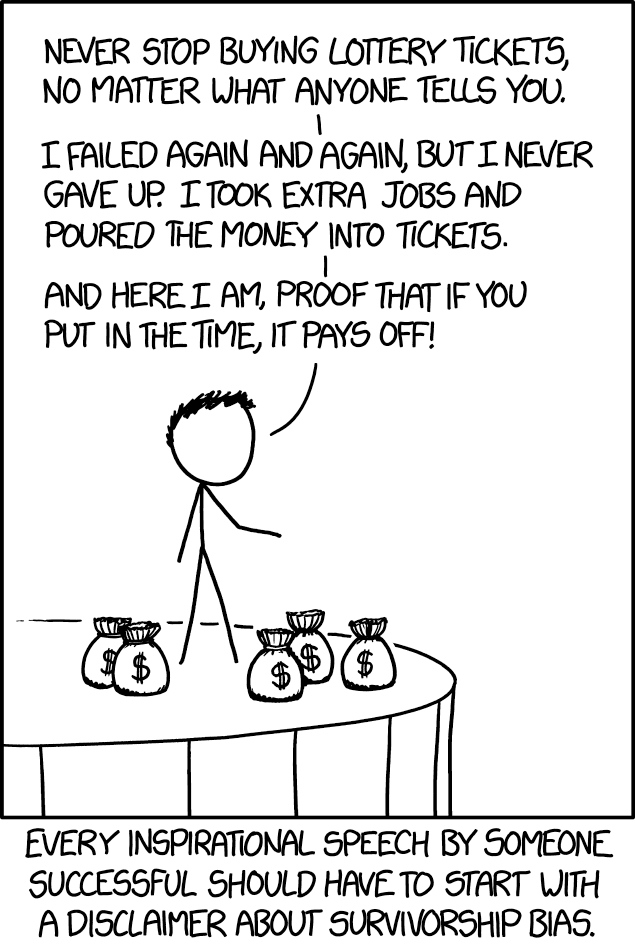
Scrutinize advice from the lucky

Never accept career advice blindly.

Sometimes I get asked to do something like a brown bag lunch talk on careers and career advice. The above comic is always the first thing that I show the audience. If I leave them with nothing else, I want them to not simply follow the advice of some schmuck like me just because I/we have achieved some measure of “success”. If I can get the audience to think critically about my presentation then I have succeeded in the most important goal.

I like to think that I am reasonably good at what I do. After ten years in academia and twelve years in industry I have learned a few things that make me more effective as a researcher, engineer, and manager. Still, a significant degree of luck has also shaped my career path. Here are a few, off the top of my head:

1) Having my grad school interview schedule changed at the last minute and randomly meeting the person who would be my future advisor.

2) Finding a great postdoc position because I literally ran into a professor at the Cognitive Neuroscience Society conference in New York and he said that his lab had a job available.

3) My first software manager deciding to take a risk and hire me even though I had no formal training as a software engineer.

4) Getting my first software management position because the CEO happened to remember that I organized large research projects as a postdoc.

5) The startup I joined getting acquired by a FAANG nine months after they almost ran out of money and laid off 30% of the company.

Hard work is always necessary. A little bit of luck can make all the difference though. Survivorship bias pops up when only the successful people are around at the end. Put another way, the people who have gotten lucky are much more likely to be giving presentations than the people who never got a fortunate nod from the statistical universe. Always know that.

Comic from XKCD: https://xkcd.com/1827/

Associated explainer: https://www.explainxkcd.com/wiki/index.php/1827:_Survivorship_Bias

Shine bright, but don’t burn out

I have ridden the burnout train before. It was a miserable experience.

Rewind to 2020. The startup I had joined in 2016 was acquired by a FAANG company in 2017. The new company gave us a healthy grace period to ramp up, but as time marched forward the corporate expectations on our org grew ever-larger. Information security demanded an audit. Finance dictated we shrink cloud spending by 10%. API response latency was up and we needed to bring it down by 50ms. I was running the SRE team, and it was becoming a lot.

The point I knew something was wrong was when I got paged during Thanksgiving 2019. We had traveled to the Sierra Nevada mountains with friends and the feast preparations had begun. My pager went off. I sprinted upstairs to grab my laptop, sliding in my socks on the carpet. My knee went down hard into the floor. 

I opened my laptop, saw that a service had run out of memory, restarted the instance, and went back to my holiday business. Total distraction time: 15 minutes. As I nursed my rug burned knee something was clear to the people in the room that was still dawning on me: I was hating every minute of my job.

The hate I felt wasn’t toward any person or any situation. It was a generalized frustration and irritability. I hated that I was underwater. I hated that I felt frustrated by my workload. I was quick to anger when things didn’t happen properly. I wanted to blame my manager, but I knew that I had willingly taken on my responsibilities. I hated that I shot myself in the foot by not communicating more effectively with my manager. That fact made me even more frustrated, but purely at myself this time.

The next week I (finally) talked with my supervisor and let him know that I was burnt out. He moved quickly to lighten my load and divide some of my responsibilities. This didn’t fix my burnout, but it did provide some breathing room. It was also a great career advancement opportunity for my peers. In hindsight, by holding on to so many responsibilities myself I was preventing others from demonstrating the skills to get them promoted. That is a blog post for another time…

My burnout recovered bit by bit. It took six months, but by the next summer I was feeling back to “normal”. Still, that July a former coworker let me know about a great new opportunity with their company. If I didn’t just go through burnout recovery I probably would have ignored him. Because I was still harboring some of that frustration and irritability I ended up saying “yes” to the recruiter when they reached out. The rest is history.

What can we learn from all of this? I think there are several lessons, but we can break them down into three for now:

1) Be vigilant for signs of burnout in yourself and your employees. Steer clear early.

The total cost for a bad case of burnout is high, for both the business and the individual. It is far better for everyone involved to steer clear of burnout as soon as the early signs are present. Don’t wait for them to say they are overloaded. Constantly ask them about their stress level, their workload, and week-to-week changes in their relationship with their work.

2) Burnout may hit your most-engaged people hardest.

In retrospect, the root cause of my burnout was a failure to say “no”. I wanted to help the org whenever we were in a tough spot. I had the skills and the knowledge to address problems that were constantly popping up. Why shouldn’t I help? I felt needed and I felt important. It felt good. However, the constant piling-on just served to erode the foundations of my motivation until it all collapsed on itself.  If you have someone that is constantly volunteering to take care of challenges make sure to check in with them more often.

3) Recovery from burnout can take ages. 

It is not a matter of just fixing the issues or dialing down the total amount of work. I can say with authority that it is an effortful journey back to an engaged state of mind. Time away from work, new challenges, resetting expectations, and setting boundaries are just a few things that can help.

None of this is pleasant. None of this is happy. I think the best step toward addressing burnout as an industry is to talk about it. If a manager decides to consciously ignore burnout as a factor and optimize for short-term deliveries from their team then, hey, more power to them. If you have a desire to optimize around the long-term success of your organization then navigating the burnout cycle is a critical pillar of sustainable engineering.

Photo: The Amtrak Pacific Surfliner stopping at the San Luis Obispo station. It’s a beautiful ride north from Santa Barbara.

Sitting with Uncertainty

The ability to sit with your anxiety and bathe in uncertainty for a limited amount of time can be a managerial superpower.

“Project Blue” was going to be a major effort. I would need to marshal the combined resources of all my software teams to make it happen on the CEO’s demanding schedule. There would need to be all kinds of project alignment, team alignment, people alignment, and change management if the company went all-in on Blue. I was ready. There was only one problem: the executives hadn’t decided to move forward yet.

For two weeks I waited, then I waited, and then I waited some more. My hand was metaphorically hovering over the “GO” button and I needed an up-or-down decision. We were either moving 100% of available product development time to Blue or it was business as usual. Because the decision had so much gravity, with an untold number tradeoffs, the final decision was not forthcoming.

One of my favorite quotes ever is “nothing clears the mind like no choice”. While I did push the CPO for a decision, I knew that the executives had to complete their discernment process to know with confidence which direction to go. This would take time. The decision was out of my control.

What is a manager to do at this point? My advice is to hone the fine art of sitting with your uncertainty and anxiety. Yes, absolutely take action where you can and advocate for the direction you think is best. At the same time, also understand that it may be days or weeks until the uncertainty is resolved.

If you let the uncertainty eat at you then you only end up worn down and burnt out. Not the best way to start a major project. Instead, clear your mind, be comfortable that you have done everything you can, provide additional input where asked, and wait for clarity.

As an aside, we did end up moving forward with Project Blue but with a new project definition that meant the effort from my teams would not be needed. Business as usual…

Photo: Tail rotor assembly from an MH-65E “Dolphin” helicopter of the United States Coast Guard at the Camarillo Air Show. Don’t stick your hand in there.

The power of a manager README

The first 90 days of a new hire matter as much for you as it does for them. Get started on the right foot by providing documentation on your management style.

I’ve had periods of managerial stability in my career and periods where I didn’t even know who I was reporting to. In the twelve-month period from 1/22 to 1/23 I ended up reporting to four different people, including one CISO, one VP of Engineering, and two CPOs. That was… a lot.

Every person you report to is as unique as a fingerprint. To have any hope of building an effective relationship you must learn about them and get to know their values, style, and preferences. For example, I had one manager that wanted a one-pager filled with discussion points prior to every 1:1. I continued this practice for my next manager…and they never read it. Instead, each week they simply wanted a verbal update on how they could best support me and my teams.

The core problem isn’t so much that every manager is different. Instead, the problem is that it takes TIME to understand them. That time can vary from weeks to months in duration. What would you pay for a magic wand that you could wave to cut that time in half? No joke – what would that be worth?

What if it cost nothing? What if all it took was 1-2 hours of effort to fill out a doc template?

The Manager README doc is a widely-known management tool, but it is one that I have only seen rarely in practice. In short, the goal is to put a doc in front of your new reports during their first week that empowers them with information about you, your role, your expectations, your quirks, and more. It contains all the little nuggets of wisdom that someone would learn across dozens of 1:1 meetings, all condensed into a few pages of text.

Here is my README. It is far from perfect. Parts are incomplete, and some sections are getting a bit dated. Still, it is a great doc for me since it consistently delivers on its purpose: generating high-quality conversations with my direct reports. When you finish reading mine, maybe consider writing your own.

https://github.com/prefrontal/README

Some other READMEs to check out:

https://hackernoon.com/12-manager-readmes-from-silicon-valleys-top-tech-companies-26588a660afe

A site to write and share READMEs:

https://managerreadme.com

Photo: A help kiosk at Los Angeles International Airport, being as useful as it can.

Where to Jaywalk

Always work to identify your major project risks, then work to mitigate those risks in whatever way that you can.

I had to jaywalk the other day. Well “had” is an exaggeration, but it was the best option relative to walking another block in either direction. The street had light traffic, so the risk of crossing was pretty low. There was something else that helped mitigate the risk: I was across the street from our local hospital, containing the only Level I trauma center between San Jose and Los Angeles.

We’ve been talking a lot lately at work about how to empower teams and maximize their velocity. One mechanism was through guard rails. If you clearly define what is in-bounds and out-of-bounds then teams don’t have to waste time asking about what is possible, they can just execute. The other mechanism was that of safety nets. It is easier to take risks when the consequences of those risks have been reduced or eliminated. That can be minimizing the possibility of something happening or reducing the impact of a risk if it does come to pass.

So, project-wise, if you are going to jaywalk then do it at the hospital.

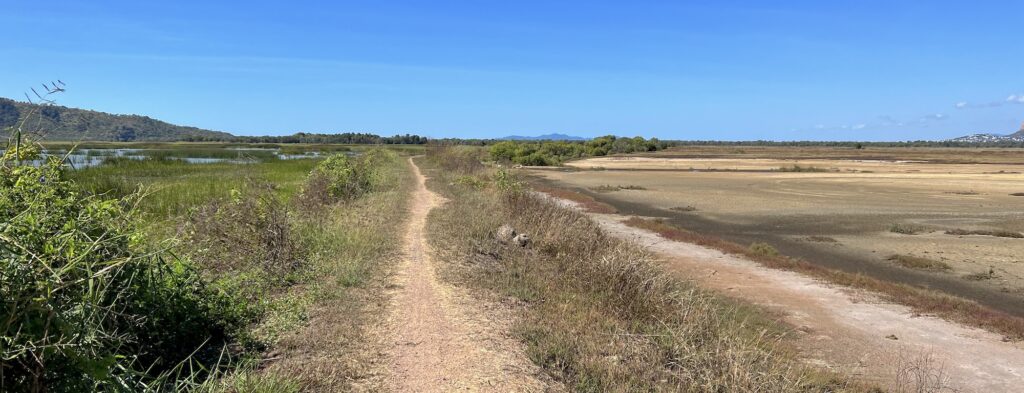
Photo: Freshwater Trail in the Townsville Town Common, Townsville, Australia. The only time I have come within five feet of a croc while mountain biking. No, there was not a hospital nearby.

Rain Boots and Sandals

There are many strategies that can lead to project success. It often pays dividends to consider alternatives, even when the proposed paths are wildly different.

My current random cycling goal is to ride every street in my home town of Santa Barbara, CA. This has led to a lot of evening and weekend bike rides through every neighborhood in the city, one cul-de-sac at a time. I have also ridden in a wide array of weather conditions.

A few weeks ago I was slogging along through a neighborhood in the foothills during a light rain. I was a bit wet, a bit cold, and wishing for the rain jacket that I foolishly left behind. During the ride I happened upon a pair of people out for a morning walk.

They were each happily walking through the rain and running water on the street. They each had a different approach to the problem though. One wore waterproof boots that rose to almost her knees. These rubber boots were certain to keep out any water on the ground. Feet dry – mission accomplished.

The second person took a different path forward: they wore sandals. Their feet were 100% soaked, but they hardly seemed to care since they no longer needed to worry about preventing water intrusion. Their toes may have been a bit cold, but they didn’t have to worry about the water anymore.

So, keep your mind open to alternative approaches as you solve problems. You never know when it might be time to remove your boots and throw on your sandals. Just remember your jacket…

Photo: Rainbow over the east side of Santa Barbara.

They’re always getting recruited

It is naive to think that your engineers aren’t getting pinged constantly about new job opportunities. You should act like it.

I have an admittedly love/hate relationship with LinkedIn. It is an infinitely useful tool for building, indexing and maintaining a professional network. It can also be a morass of sales and recruiter spam. I am admittedly part of that problem, having sent hundreds of recruiting emails to interesting candidates. Everyone I have talked with reports the same thing: recruiters are constantly sending them messages on the site.

I won’t lie to you – it bothers me that people are out there constantly tempting my team members to leave. Recruiters can sing any number of siren songs to find the right leverage. Need money now? Boy, do we have a great signing bonus. Looking to improve your total compensation? Let’s chat about our equity vesting schedule. Want an interesting technical challenge? We have a new team spinning up and you can hack to your heart’s delight. The grass is totally greener on this side – just sign here…

So, what can you do with the knowledge that recruiters are banging on the door of all your engineers?

It doesn’t matter. Nothing new is needed. You focus on fundamentals.

Your forever-goal is to create the kind of team that people would hate to leave. The kind of team that people doubt can be replicated elsewhere. The kind of team that always presents unique opportunities to engineers. These goals will be true whether recruiters are pinging your people or if their inbox is completely empty.

Your people will leave you. Your best people will leave you. I am never hurt or offended when I know that people are leaving for a new opportunity that I can’t provide them. I am hurt, and potentially offended, when people leave for reasons that are entirely within my control. Build the team that you would hate to leave and you will be halfway to your goal already.

Photo: Arch Rock on the east side of Anacapa Island within Channel Islands National Park.

“What else?”

Ask “what else?” and keep asking until the room is silent.

Program management gets a bad rap at times. Ask twelve people what a program manager does and you will get a dozen different answers. The best description I ever heard was from a career talk during an internal Amazon technical program manager (TPM) conference: “I don’t know what program managers do, but things seem to go far better when they are around”.

One of the best TPMs I ever worked with had a pro-tip that he swore by. It is so simple that it seems obvious, but it is still a rare occurrence in meetings. After we had worked through the meeting agenda he would ask “ok, what else?”. That would inevitably lead to a missed agenda item that should have been discussed. “Great, thanks. What else?” Someone would volunteer that there was a risk that hadn’t been documented that should be. “Awesome, what else?” Suddenly an engineer would share that we need to talk with our third-party vendor. “Fantastic, what else?”

“What else?”

I am convinced that these two magic words have saved more projects than I have fingers.

Asking “what else” changes the focus of any meeting from simply completing the agenda to truly understanding the state of the project. It also communicates that the goal is to suss out all challenges and blockers, not just to check things off of a list. This subtle shift is powerful.

Don’t be a slave to your agenda. Focus on success of the project. Make sure that all challenges and blockers have been discussed. Ask “what else” until it hurts. Ask it three times in a row. Ask each person individually. Whatever it takes to get a shared understanding of ground truth.

Photo: Ball made of used bike tubes in Breckenridge, Colorado.

The Punctuated Equilibrium

Always be at the top of your game.

Performance across teams always tends to increase as review season comes around. Individuals know that they are about to be evaluated by their manager and, consciously or unconsciously, they ramp up their output. I see it as an attempt to put their best foot forward and a chance to capitalize on recency bias. All in all, it is a very smart move.

But it is not a smart move. You need to be at the top of your game, always.

Opportunity is a random process. You never know when the unexpected will happen and a previously satisfied business need is now a business need unsatisfied. If that happens during review season, and your stats are up, then what an amazing coincidence. If it happens outside of review season, and your stats are off, then you have missed an opportunity.

Like many, I have often thought of career progression as a linear march. You continuously move in a straightforward fashion toward the next level, occasionally getting promoted. With more experience, I now see career progression as a kind of punctuated equilibrium. Things are relatively stable until such time as they are not and dramatic change can happen very quickly. The goal, your goal, is to always be well-positioned for those periods of change.

I feel this is important because this randomness has shaped, and perhaps defined, my personal career. The first time I became a software manager was when my then-current supervisor decided to leave the company for a new gig at Apple. He went to the CEO’s office and tendered his resignation. After some discussion, and an attempt to retain him, the CEO asked “how should we handle your replacement?”. My supervisor responded that “Craig has been really crushing it lately and has relevant experience”. The rest is history.

Anticipating your question, no, this was well after that year’s review season.

Time and again I have observed people who have missed opportunities because they weren’t positioning themselves to be prepared for it. There is a lot of power in acting like you belong at the next level because you never know when that opening will appear.

You will always have a down day here and there where nothing seems to click. That is natural and can’t be avoided. Don’t let off the gas though, even if it looks like opportunities are sparse. As Robert Abelson famously said “chance is lumpy”.

Photo: Lightning strikes the Santa Ynez mountains north of Santa Barbara, California.