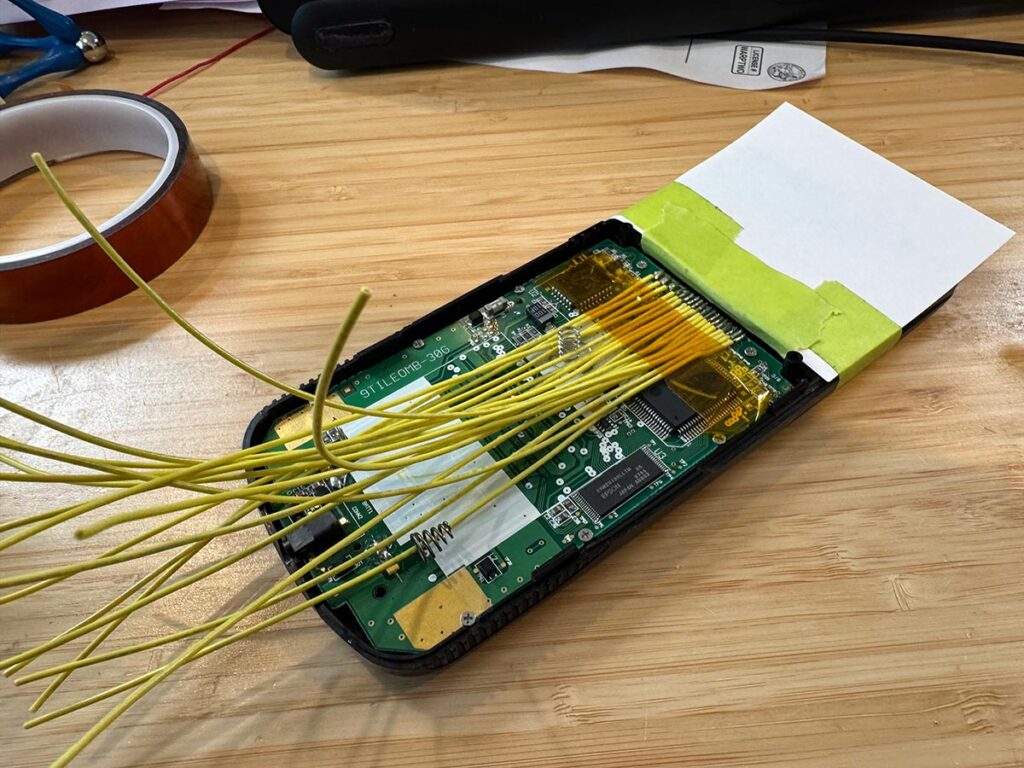
If we are going to put a new screen in the TI-86, then we will need to understand how the current screen is getting data. With any luck, we can then parse that data, transform it, and output the screen data to a modern display with a different protocol.
Cracking open the calculator case, we have our first bit of info: there are 18 conductors in the ribbon cable. Maybe some kind of parallel interface? Let’s see if anyone else on the Internet has blazed a trail and identified what they are.
This is a Texas Instruments TI-86 calculator. More to the point, this is MY Texas Instruments TI-86 calculator. Released in 1996, it was the pinnacle of TI graphing calculators when I bought it.
I have owned a lot of graphing calculators over the years. I somehow talked my dad into getting me a TI-81 in middle school. I spent hours programming in TI-BASIC, even porting code from a library book to create a Sierpiński triangle on the 96×64 screen. It was a joy. From there, I bought myself a TI-85 in high school. I got the TI-86 my freshman year in college. Later on as an undergrad, I spent some time with a TI-92 and TI-89 just for kicks.
The TI-86 was always my favorite. So it has been for the last twenty-ish years: a TI-86 for daily use and a TI-89 for the memories.
Until a few weeks ago.
I hit the “On” button on the TI-86 and was greeted with random noise on the screen. I changed the batteries. Nothing. I replaced the lithium backup cell. Nothing. I performed every kind of reset I could think of. Nothing. To the best of my knowledge, it appears that a RAM chip failed.
Damn.
So, I had a TI-86 with a good screen and a bad main board. Not content to let a multi-decade companion walk into the sunset, I went on eBay and bought another TI-86 with a bad screen and a good main board. A few hours of Frankenstein soldering later, and my original college calculator was working again. I even threw on a colorful set of keys from a TI-83.
But… why stop there?
My one complaint about the TI-86 has been the screen. While it was a substantial upgrade over the TI-85, without a backlight it was always hard to read. Let’s fix that. Over the next few posts we will explore the TI-86 display protocol and give it the OLED upgrade that it always deserved.
Don’t lose your humanity when you have to make the tough decisions.
I can hear the train coming, and I wish like hell it would never arrive.
It is Saturday morning. In 72 hours approximately 25% of the employees in my org will be laid off. I won’t go into why. Suffice it to say that costs are up and revenue is down. The net result is that I have to do one of the most terrible actions that a manager may need to take: dismiss high performing employees that did nothing wrong but will lose their job regardless.
It is said that you never really become a manager until you have to manage out an underperformer. The struggle of coaching someone to do better, the realization that they are unable or unwilling to improve, and the action to remove someone from a company is profound. I am still early enough in my career that I can remember the separation meetings of every person that I have let go. Yes, even the first one ten years ago.
The small solace of managing out an underperformer is that they are not delivering. Through coaching, 1:1s, and performance plans we can try to coax and cajole people into doing better. If they don’t want to change then it is the individual who decided to leave by not engaging.
The opposite is true in a layoff. These are often people who have been doing everything right. They have been working hard to deliver impact for the company and provide what is needed within their teams. Then, suddenly, we tell them “thanks for the hard work, but we’ve decided that we don’t need you any more”.
The dollars-and-cents of a layoff, and the spreadsheets that accompany them, very intentionally work to depersonalize the decisions. People become a column, a row, a single cell. We are playing a game of Tetris to achieve a certain dollar amount or to obtain a percent savings target. I don’t know an empathetic soul would could survive the process without putting the human element somewhat to the side. As is true of many/most terrible actions, it often slowly becomes a case of “I am just doing my job”.
Tuesday will come. I will do the right thing for the company and complete the layoff. Then, Wednesday will come and the sun will rise again. The Earth will spin on. I will march forward with the remaining 75% of my org, laboring to manage the massive changes. It will not be lost on me how terrible the layoff is though, nor will I forget the sacrifices of hard working people that were necessary to reduce our costs. They are more than just entries in a spreadsheet.
Photo: The Santa Ynez mountains above Summerland, CA burn during the Thomas Fire in December 2017. At the time it was the largest wildfire in California history.
If you want to enable change then you must be an active participant.
It was the mid-2010s and I was working as the head of software for a local scientific instrument manufacturer. The executives were looking for ways to increase velocity and urgency. They felt that the company had slowed down significantly in the last few years.
During an all hands meeting the President of the company got up and described how we would be enacting lean manufacturing principles. One element of this approach was “going to gemba”, with gemba representing where value was created within the company.
The President told anecdotes about leaders putting their office, or at least a desk, right on the manufacturing line. The goal was to see and hear the opportunities to unblock work and improve processes. This was part of genchi genbutsu, where the only way to understand the manufacturing floor was to actually go there. Toyota executives would talk about the daily “gemba walk” where they would move through the manufacturing center to observe and identify inefficiencies.
Following the all hands we collectively waited for a member of the executive staff to move their office from the front of the building to the manufacturing area in the back. At the very least we expected them to begin regular walks through the area.
It never happened.
Nothing undermines change management like hypocrisy. In this instance, the leaders of the company were asking everyone at the company to make major changes. People were expected to suffer whatever sacrifices were necessary to make those changes successful. We were told that this was required to ensure that the company would be competitive into the future. Then, when it came time to enact those changes, it was clear that the executives were not willing to make sacrifices themselves.
Why should anyone else in the company commit to a major change when the executives refused to change any element of their work?
Two years later we got a new CTO who was hired by the executives to improve R&D and manufacturing. The first thing he did was kick an engineer out of a well-placed R&D cubicle so he could sit at the intersection between R&D and manufacturing areas. This resonated with everyone in both departments. The message was clear: he was there to be a part of the problem solving.
In the end, there are two lessons to take away. First, leading by example is critical and nothing torpedos change management like hypocritical “for thee, but not for me” leadership. Second, it does pay dividends to get close to the value creation in your company. Maybe you don’t have to give up that front office 100% of the time, but set up shop in the back of the building at least a few times per week. Your gemba is likely there.
Photo: One last peek at my desk at Amazon before we moved to a new office in downtown Santa Barbara, CA. We were in the new office for about two months before COVID hit and we scattered to work remotely.
Only you can decide how to define your voice. Will you gravitate to the content that is most popular, or will you gravitate to the content you think is most important?
I had Google Analytics (GA) enabled for my last weblog at prefrontal.org. It was exhilarating to see how many people visited, which pages they went to, and where in the world they were coming from. GA was a powerful lens to evaluate the attention of my audience so I could dial in my content. When I saw an uptick in traffic on a post about neuromarketing I kicked out a new longer article that got some nice attention.
I have given up on that approach for this site. I am not going for page views, or clicks. I am thinking more about impact, as I define it.
The charter of this site is to be the resource I wish I had when starting out as a software manager. Having site analytics is not required to achieve that goal. Perhaps it would help, but when using GA it feels like I am no longer writing the articles that I think are most impactful. Instead, I am letting the metrics lead me where they want me to go.
One of my favorite jokes takes that approach to an extreme: “With enough A/B testing, every website becomes a porn site.”
Having analytics on your site is more-or-less standard these days. I don’t even want to dissuade you from using tools like GA since they can be so empowering. My only advice is to think twice about why you need analytics and whether it is helping you achieve your goals.
Don’t be afraid to turn the analytics off either. You can always turn them back on later – the best kind of two-way door…
Photo: Thousand Steps access path to the beach in Santa Barbara. At high tide it is often a path to nowhere. Fun fact: there are far fewer than 1,000 steps to get to the ocean.
How you invest your time will determine where you go from here. Are you investing in the right areas?
I have posted before about my former adventures as a sports photographer. You can read one post on that journey here. The story of why I left photojournalism is probably every bit as important.
I was drawn to photography as a unique intersection between technical and creative work. How to gather light is a science. How to frame that light to create a beautiful or engaging photo is an art. I loved both aspects. I started taking pictures for the University Daily Kansan at the University of Kansas during my sophomore year.
Every weekend I would trundle out to the football field, basketball arena, or the track. Every weekend I would shoot hundreds of photos of people pushing themselves harder than ever. They were in competition. They were finding their limits. They were part of a team, and they didn’t want to let the team down. Every week I was impressed by their commitment and fire. Every week I grew more disappointed in my own drive and ambition.
It’s not that sports photography is easy. It is uniquely challenging. The light, the angles, the speed – it is as technically difficult as anything I have done in photography*. With that said, once you have your techniques dialed in then each new event is less of a challenge. It becomes “cookie cutter” where you begin applying the same formula again and again, achieving similar results. Maybe you can find some room for creativity. Maybe something extraordinary happens during an event and you are there to catch it. Those times are rare though. That is not growth.
In my junior year I had to take a hard look at where I was spending my time. It was pretty easy to see that how I spent my hours did not align with my long-term goals. I left the Photography department at the campus newspaper and signed up to work as a volunteer in a neuroscience lab in the Psychology Department. They were using EEG techniques to evaluate event-related potentials from the brain in language. The professor in charge of the lab became a trusted mentor and was a key recommendation when I applied to grad school twelve months later.
With the benefit of 20 years of hindsight, it was absolutely the right move.
It is FAR too easy to get into a rhythm of work that is enjoyable but doesn’t serve your long-term interests. For many of us, this will manifest as staying in a job well beyond the point where we are still growing. We implicitly or explicitly accept stagnation. In that case, it isn’t hard to predict where you will be twelve months into the future: almost exactly where you are at today.
* Astrophotography is a whole other level, so we will leave that to the side for now…
Photo: Las Alturas Road in Santa Barbara. The switchbacks are epic, especially with a wide angle lens.
I’ve been an aerospace geek since, well, always. In the great book of life there is a value representing the excessive number of times I watched the movie Top Gun as a child. There is another extreme number for the count of crazy Lego spacecraft I have built. I probably don’t want to know the number of dollars spent on pilot training, but anyway…
It is in that context that I feel compelled to tip my hat in the direction of SpaceX on their successful “catch” of the Starship first stage on October 13th.
That was the equivalent of a 20-story building maneuvering to a precision landing and being caught by a pair of manipulator arms. Absolutely unreal.
The last time I felt that level of aerospace exuberance was when SpaceX simultaneously landed two Falcon Heavy boosters at the same time. I watched that scene in a conference room with about 20 other software engineers, who were all going crazy with excitement at what we had witnessed.
Pretty much anything great comes from constant iteration. The vast majority of the time, it is better to start building and learning than taking forever to create a perfect plan that is uninformed by experience.
Last year I had to get a halloween costume with 48 hours of notice. I decided to go with something easy to pull together: a classic Star Trek uniform. Black shoes, black pants, a gold shirt (command staff, naturally), and a tricorder mockup. All I needed was the badge to put on the shirt.
There wasn’t time to order a badge online, so I turned to my 3D printer. I found a few badge files online and began the process of iteration:
#1: Too small, needs to be bigger
#2: Right size but had a printing error, so couldn’t really try the vinyl overlay
#3: Tried to use cut vinyl for an overlay, but it was hard to place and didn’t look good
#4: Try it a bit smaller. Ok overall shape
#5: Printed a gold final version, but the vinyl star still didn’t look great
#6: Made a window in the top layer and put a black layer underneath. Still looked messy.
#7: Combined elements of the previous tries: larger badge, flatter height, and a smaller window for the black layer underneath. SHIP IT.
If there is one thing that 3D printing has taught me is that you often need to just give it a try and see how things turn out. All the preparation in the world in a CAD program helps, but nothing is better than printing your current best guess and holding that iteration in your hands. Sure, you will print a few things that get thrown immediately into the trash can. Fortunately, plastic is cheap and the rate limiting step is just the time it takes to create a print.
I had been at my current company for just a few months the first quarter of 2020. We were working on a major new vendor integration. A staff engineer on my team came to me and said “we have been planning the project for four weeks, but we will need four more weeks to complete the planning and be ready to start coding”. I weighed my options. I trusted him, and I trusted his assessment that more time was needed for planning. At the same time, I knew that we had to begin the process of iteration so we could learn how the product plan would come together in real life.
“No. I’d like you to work with the team and start coding next week. Even if we have to throw away the code, we need to start building.”
It was a risk on my part, but a calculated one. In the end, I asked what the team needed more. Did it need greater knowledge of the vendor interface or did it need greater knowledge of using the interface in real world circumstances? I decided it was the later. While it is impossible to say if this was a key project decision, we did end up shipping the system on time that quarter.
It would be cavalier to leap into a big project with zero planning. Likewise, if your goal is to reduce risk to zero then you will be planning forever. The key element then is finding the right balance between speed and risk. One of the best ways to reduce risk is by gathering data on real world operation through constant iteration. Gaining experience and letting data guide you is worth many weeks of conversation on theoretical points.
Photo: The iterations on the badge, starting from #1 on the left to the final #7 version on the right. Hot glued some magnets to the back and I was in business.
There are pivotal moments that can ruin promising careers. Don’t lose it all because you were self-focused and couldn’t stop yourself.
I learned a lot about how the brain works while in grad school. One thing I learned is that the brain largely works through inhibition. That is, you don’t so much “hit the gas” to do something as opposed to “tap the brakes” to ensure the right things happen.
Think about that one moment where you wanted to do something so bad but decided not to. It could be something innocent, like wanting to call in sick and sleep longer but you went to work anyway. More dramatically, it could be something like a time when you wanted to yell at your boss but kept your mouth shut instead.
Most decisions have a small blast radius, but there exist a small number of pivotal decisions with the power to blow up entire careers. The ability to stop yourself and inhibit your initial response is a critical skill for leadership. It really is the thing that separates long-term success from sudden and dramatic failure. This is because it takes years to build the foundation for success and only moments to tear it all down.
Let’s explore four short examples where leaders, and people that I had respected, threw it away.
It’s not your money
An acquaintance was the head of a local city department. He was seen as an effective leader, well liked by his staff and city leadership. Things were going well, but this individual had a deep political streak. The Republican candidate for mayor stopped by his office and they talked about how desperately the city needed conservative leadership. The acquaintance agreed, and (allegedly) gave the candidate money out of the petty cash box to help fund his campaign. Let’s pause for a second. This was city money given to a political candidate – a huge mistake. A disgruntled member of his staff reported the incident and the leader was investigated by law enforcement. He quit the job and moved out of town before he would be forced to step down. Years of investment gone in an instant because he couldn’t stop himself in that moment.
Don’t date your followers
A new minister moved to town and was a huge hit with his congregation. He brought a new, youthful energy to his work that inspired and invigorated the church. Over several years he built a dynamic new organization, always pushing to do more and serve the community in new ways. This included helping to heal wounds from decades past, when a previous minister engaged in unprofessional sexual conduct with congregants. The new minister was a superstar.
Five years after he first arrived the minister was leaving for a larger role with a bigger congregation. As he moved away it became apparent that the minister was cheating on his wife with one of the local congregants. He continued to behave badly in his new role. Three years later he was under investigation and put on administrative leave for inappropriate relationships with congregants. He was dismissed from the congregation and ultimately resigned his fellowship with the larger faith pending allegations of ministerial misconduct. An incredibly promising minister and a career that benefitted hundreds or thousands of people – all of it thrown away because he couldn’t be trusted with the people of his congregation(s).
Perceptions matter
The best conference I attended while in academia was the “New Horizons in Human Brain Imaging” gathering in Hawaii. Small conference. Great talks. Amazing location. On the last night of the conference in 2010 I was with several attendees in the hot tub hanging out and talking shop. As we talked one of the professors and a postdoc started touching and whispering to each other. They jumped out of the hut tub and chased each other around for a minute before chasing each other into the bushes. Another attendee mentioned “isn’t he married?”, to which a second member of the hot tub responded in the affirmative. Rumors only grow after an episode like that. Conversation about the conference continued for years afterward.
The ultimate misappropriation of trust
The worst cases of professional malpractice were those I saw in grad school. Twenty years ago the Psychological and Brain Sciences department at Dartmouth College had a very permissive atmosphere. The lines between professors, postdocs, and grad students got very blurry. It was not unusual to walk into a local bar* and see professors drinking with grad students like they were in their 20s again.
The grad students knew which professors were “handsy” and who got a little too close for comfort. Several people switched labs when they found out the hard way that their advisor was a creep. Some had affairs with professors. Permissiveness continued to escalate over time. Eventually, three professors clearly crossed the line and were dismissed. The resulting lawsuit cost the College at least $14M dollars. The details of the situation are worth their own separate post, but suffice it to say that three promising professors ruined their reputations and their careers because they couldn’t control themselves**. More critically, they hurt a lot of people over many years in the process. The misconduct allegations in 2018 were a contributor to the department chair taking his own life one year later.
Summary
I have heard leadership defined as helping any group of two or more people achieve their common goals. We leverage respect, influence, and power to make that happen and move our group toward those goals. That same respect, influence, and power can also be misappropriated to further selfish ends. This action is incisive, and it cuts deep. Not only do we abuse the trust of those within our leadership but we harm our own advancement by behaving badly.
Don’t fall into this trap. Don’t throw away your shot at greatness. Make sure to hit the brake pedal when the time is right. It matters, both to you and the people under your leadership.
* Hanover, NH was a small town of 8,000 people, so you run into others often.
Photo: A Founder’s Fizz, from the Richard Rodgers Theatre in 2016 as we watched Lin-Manuel Miranda and the original cast of Hamilton perform. “My Shot” is one of the best songs of the show.